
Genetic diversity and multilocation field performance of mung bean (Vigna radiata) accessions
DOI:
https://doi.org/10.71336/jabs.1551Keywords:
Agronomic traits, cluster analysis, genetic diversity, mung bean (Vigna radiata), principal components analysisAbstract
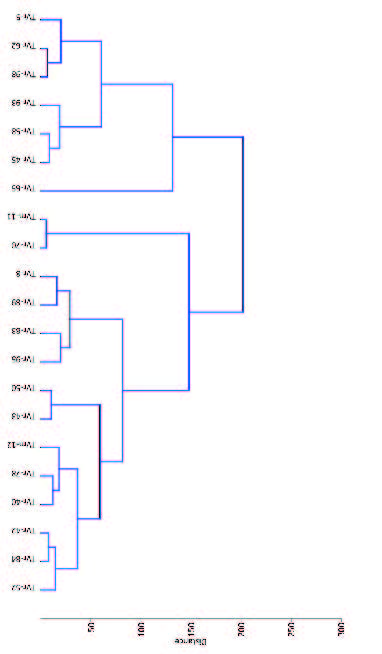
Genetic diversity provides the necessary accessions needed for breeding programs that aim to develop varieties that are more resilient to biotic and abiotic stress, have higher yields and can adapt to changing climates. Twenty-one selected mung bean accessions were assessed for their field performance, genetic relationships and potential for agricultural improvement. The study was carried out at Ife, Ilora and Ballah in the 2023 cropping season. A randomized complete block design (RCBD) with three replications was used for the experiments at each site. Agronomic, yield, pest and viral disease rating data were collected and analyzed. The location effects were highly significant for all traits. Significant differences were also observed for key agronomic traits including days to 50% flowering and podding, viral severity, insect rating, pod length, and terminal leaf length. Accession TVr-83 had the longest days to 50% flowering and podding. TVr-52 was the most susceptible accession to viral infection and TVr-42 was the most resistant line for pod borer rating. Cluster analysis grouped the accessions into four clusters. Cluster 3, consisting only of TVr-65, exhibited the highest pod weight, while Cluster 4 combined moderate maturity with relatively high yield potential. Principal component analysis revealed that days to 50% senescence, pod weight, and flowering and podding times were major contributors to variation. The findings highlight the presence of useful genetic variability among the accessions, with implications for breeding programs aimed at improving yield, pest resistance, and adaptation.
References
[1] Ha J, Lee SH. Mung bean (Vigna radiata (L.) R. Wilczek) breeding. In: Advances in Plant Breeding Strategies: Legumes 7. Cham: Springer International Publishing; 2019. p. 371–407. DOI: https://doi.org/10.1007/978-3-030-23400-3_10
[2] Nair RM, Yang RY, Easdown WJ, Thavarajah D, Thavarajah P, Hughes JDA, et al. Biofortification of mungbean (Vigna radiata) as a whole food to enhance human health. J Sci Food Agric. 2013;93(8):1805–1813. DOI: https://doi.org/10.1002/jsfa.6110
[3] Diatta AA, Abaye O, Battaglia ML, Leme JF, Seleiman M, Babur E, et al. Mungbean [Vigna radiata (L.) Wilczek] and its potential for crop diversification and sustainable food production in Sub-Saharan Africa: a review. Technol Agron. 2024;4(1):e031. doi:10.48130/tia-0024-0030. DOI: https://doi.org/10.48130/tia-0024-0030
[4] Shahid N. Legumes production under changing climate. In: Climate Smart Agriculture for Future Food Security. Singapore: Springer Nature Singapore; 2025. p. 191–221. DOI: https://doi.org/10.1007/978-981-96-4499-5_8
[5] Nair RM, Pandey AK, War AR, Hanumantharao B, Shwe T, Alam AKM, et al. Biotic and abiotic constraints in mungbean production: progress in genetic improvement. Front Plant Sci. 2019;10:1340. doi:10.3389/fpls.2019.01340. DOI: https://doi.org/10.3389/fpls.2019.01340
[6] Pratap A, Douglas C, Prajapati U, Kumari G, War AR, Tomar R, et al. Breeding progress and future challenges: biotic stresses. In: Nair RM, Schafleitner R, Lee S-H, editors. The Mungbean Genome. Cham: Springer; 2020. p. 55–80. doi:10.1007/978-3-030- 20008-4_5. DOI: https://doi.org/10.1007/978-3-030-20008-4_5
[7] Gayacharan, Archak S, Gupta K, Gupta V, Tyagi V, Singh K. Mungbean genetic resources and utilization. In: Nair RM, Schafleitner R, Lee S-H, editors. The Mungbean Genome. Cham: Springer; 2020. p. 9–25. doi:10.1007/978-3-030-20008-4_2. DOI: https://doi.org/10.1007/978-3-030-20008-4_2
[8] Gokulakrishnan J, Kumar Sunil B, Prakash M. Studies on genetic diversity in mung bean (Vigna radiata L.). Legume Res. 2025;35(1):50–52.
[9] Chen H, Qiao L, Wang L, Wang S, Blair MW, Cheng X. Assessment of genetic diversity and population structure of mung bean (Vigna radiata) germplasm using EST-based and genomic SSR markers. Gene. 2015;566(2):175–183. doi:10.1016/j.gene.2015.04.043. DOI: https://doi.org/10.1016/j.gene.2015.04.043
[10] Ande OT, Huising J, Ojo AO, Azeez J, Are KS, Olakojo SA, et al. Status of integrated soil fertility management (ISFM) in southwestern Nigeria. Int J Sustain Agric Res. 2017;4(2):28– 44. doi:10.18488/journal.70/2017.4.2/70.2.28.44. DOI: https://doi.org/10.18488/journal.70.2017.42.28.44
[11] Denton OA, Alemeru MS, Fademi IO, Uthman A, Oyedele A. Assessment of the physical and chemical properties of three contrasting soils under different land use systems. Curr Res Agric Sci. 2017;4(4):96–102. doi:10.18488/journal.68.2017.44.96.102. DOI: https://doi.org/10.18488/journal.68.2017.44.96.102
[12] Sandhyarani C, Eswari KB, Sudarshanam A. Screening of blackgram PVT entries against thrips and Maruca vitrata (Geyer). Andhra Agric J. 2009;56(2):201–205.
[13] Ong PW, Lin YP, Chen HW, Lo CY, Burlyaeva M, Noble T, et al. Environment as a limiting factor of the historical global spread of mungbean. eLife. 2023;12:e85725. DOI: https://doi.org/10.7554/eLife.85725
[14] Mogali SC, Hegde GM. Recent advances in mungbean breeding: a perspective. In: Gosal SS, Wani SH, editors. Accelerated Plant Breeding, Volume 3. Cham: Springer International Publishing; 2020. doi:10.1007/978-3-030-47306-8_9. DOI: https://doi.org/10.1007/978-3-030-47306-8_9
[15] Muchero W, Roberts PA, Diop NN, Drabo I, Cisse N, Close TJ, et al. Genetic architecture of delayed senescence, biomass, and grain yield under drought stress in cowpea. PLoS One. 2013;8(7):e70041. DOI: https://doi.org/10.1371/journal.pone.0070041
[16] Seo H, Kwon H, Satyawan D, Kim MY, Ha J, Lee SH. Identification of novel loci for flowering time in mungbean [Vigna radiata (L.) R. Wilczek] using genome-wide association study. Genes Genom. 2023;45(7):911–919. DOI: https://doi.org/10.1007/s13258-023-01372-y
[17] Wingler A, Soualiou S. Overcoming physiological trade-offs between flowering time and crop yield: strategies for a changing climate. J Exp Bot. 2025;76(10):2646–2658. DOI: https://doi.org/10.1093/jxb/eraf110
[18] Shavrukov Y, Kurishbayev A, Jatayev S, Shvidchenko V, Zotova L, et al. Early flowering as a drought escape mechanism in plants: how can it aid wheat production? Front Plant Sci. 2017;8:1950. DOI: https://doi.org/10.3389/fpls.2017.01950
[19] Islam MR, Sarker U, Azam MG, Hossain J, Alam MA, Ullah R, et al. Potassium augments growth, yield, nutrient content, and drought tolerance in mung bean [Vigna radiata (L.) Wilczek]. Sci Rep. 2024;14(1):9378. DOI: https://doi.org/10.1038/s41598-024-60129-z
[20] Ganta TY, Mekbib F, Amsalu B, Tadele Z. Genotype by environment interaction and yield stability of drought tolerant mung bean [Vigna radiata (L.) Wilczek] genotypes in Ethiopia. J Agric Environ Sci. 2022;7(1):43–62.
[21] Durojaye HA, Moukoumbi YD, Dania VO, Boukar O, Bandyopadhyay R, Ortega-Beltran A. Evaluation of cowpea [Vigna unguiculata (L.) Walp.] landraces for bacterial blight caused by Xanthomonas axonopodis pv. vignicola. Crop Prot. 2019;116:77–81. doi:10.1016/j.cropro.2018.10.013. DOI: https://doi.org/10.1016/j.cropro.2018.10.013
[22] Bennett EJ, Roberts JA, Wagstaff C. The role of the pod in seed development: strategies for manipulating yield. New Phytol. 2011;190(4):838–853. DOI: https://doi.org/10.1111/j.1469-8137.2011.03714.x
[23] Gayacharan, Tripathi K, Meena SK, Panwar BS, Lal H, Rana JC, et al. Understanding genetic variability in the mungbean (Vigna radiata L.) genepool. Ann Appl Biol. 2020;177(3):346–357. DOI: https://doi.org/10.1111/aab.12624
[24] Li M, Liu Y, Wang C, Yang X, Li D, Zhang X, et al. Identification of traits contributing to high and stable yields in different soybean varieties across three Chinese latitudes. Front Plant Sci. 2020;10:1642. DOI: https://doi.org/10.3389/fpls.2019.01642
[25] Guanzon IM, Garon CG, Marcelo MF, Miguel CM, Navarro AM, Rivera RC. Shifts in biomass allocation shape yield responses of mung bean [Vigna radiata (L.)] to molybdenum and silicon. J Saudi Soc Agric Sci. 2026;25(5):69. DOI: https://doi.org/10.1007/s44447-026-00165-5
[26] Huang Y, Chen Y, Lin H. Study on optimizing density planting and fertilization strategies to increase bean yield. Legume Genom Genet. 2025;16(6):253–269. DOI: https://doi.org/10.5376/lgg.2025.16.0026
[27] Zhou M, Yang J. Delaying or promoting? Manipulation of leaf senescence to improve crop yield and quality. Planta. 2023;258(3):48. DOI: https://doi.org/10.1007/s00425-023-04204-1
[28] Chaudhary S, Priya M, Jha UC, Pratap A, Hanumantha Rao B, Singh I, et al. Approaches toward developing heat and drought tolerance in mungbean. In: Jha UC, Nayyar H, Agrawal SK, Siddique KHM, editors. Developing Climate Resilient Grain and Forage Legumes. Singapore: Springer Nature Singapore; 2022. p. 205–234. doi:10.1007/978-981-16-9848-4_10. DOI: https://doi.org/10.1007/978-981-16-9848-4_10
[29] Mahla H, Choudhary KB, Sharma R. Unveiling a novel gene inheritance model for peduncle length in moth bean (Vigna aconitifolia L.). Indian J Genet Plant Breed. 2025;85(4):773–779.
[30] Tabasum A, Saleem M, Aziz I. Genetic variability, trait association and path analysis of yield and yield components in mungbean [Vigna radiata (L.) Wilczek]. Pak J Bot. 2010;42(6):3915–3924.
[31] Allier A, Teyssèdre S, Lehermeier C, Moreau L, Charcosset A. Optimized breeding strategies to harness genetic resources with different performance levels. BMC Genomics. 2020;21(1):349. DOI: https://doi.org/10.1186/s12864-020-6756-0
[32] Salgotra RK, Chauhan BS. Genetic diversity, conservation, and utilization of plant genetic resources. Genes. 2023;14(1):174. DOI: https://doi.org/10.3390/genes14010174
[33] Aliyu OM, Makinde BO. Phenotypic analysis of seed yield and yield components in cowpea [Vigna unguiculata (L.) Walp.]. Plant Breed Biotech. 2016;4(2):252–261. DOI: https://doi.org/10.9787/PBB.2016.4.2.252
[34] Hasan BMS, Abdulazeez AM. A review of principal component analysis algorithm for dimensionality reduction. J Soft Comput Data Min. 2021;2(1):20–30.
[35] Jayagond PA, Marawar MW, Lande SS, Ujjainkar VV. Genetic variability and character association studies in mungbean [Vigna radiata (L.) Wilczek]. Int J Adv Biochem Res. 2025;9(7):1829–1833. doi:10.33545/26174693.2025.v9.i7w.5056. DOI: https://doi.org/10.33545/26174693.2025.v9.i7w.5056
[36] Fjellheim S, Boden S, Trevaskis B. The role of seasonal flowering responses in adaptation of grasses to temperate climates. Front Plant Sci. 2014;5:431. DOI: https://doi.org/10.3389/fpls.2014.00431
Downloads
Published
How to Cite
Issue
Section
License
Copyright (c) 2026 Journal of Applied Biological Sciences

This work is licensed under a Creative Commons Attribution 4.0 International License.
