
Seed Germination Responses of Dimorphic Seeds in Atriplex sagittata under Light, Salinity and Storage Conditions
DOI:
https://doi.org/10.71336/jabs.1572Keywords:
Atriplex sagittata, bet-hedging, germination, salinity, seed dimorphismAbstract
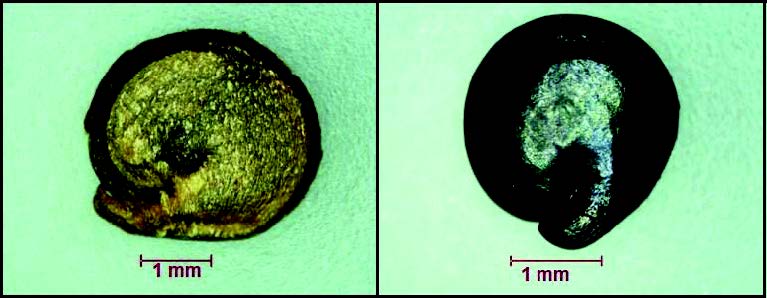
Atriplex sagittata Borkh. is an annual herbaceous plant belonging to the family Amaranthaceae with a wide geographical distribution. Like other Atriplex species, A. Sagittata produces dimorphic seeds, brown and black, that differ in size and morphology. To assess the germination responses of these dimorphic seeds under different environmental conditions, the effects of light, salinity and storage conditions were investigated. Following collection, the seeds were stored for two years under two different conditions: +4 °C and +24 °C. After, the seeds were exposed to different salinity levels. To test the effect of light on germination, parallel dark treatments were included as controls. Germination assays revealed that storage conditions had no statistically significant effect, while light increased the germination rate of black seeds. In response to increasing salinity concentrations (50, 100, 200, 300, 400, 500 mM), the inhibitory effect of salt was first observed at 400 mM for brown seeds and at 50 mM for black seeds. Overall, brown seeds exhibited much higher germination rates and greater salt tolerance compared to black seeds. Mechanical scarification of black seeds demonstrated that their dormancy is mechanically imposed.
References
[1] Imbert, E. (2002). Ecological consequences and ontogeny of seed heteromorphism. Perspectives in Plant Ecology, Evolution and Systematics, 5(1), 13–36. https://doi.org/10.1078/1433-8319-00021 DOI: https://doi.org/10.1078/1433-8319-00021
[2] Venable, D. L. (1985). The Evolutionary Ecology of Seed Heteromorphism. The American Naturalist, 126(5), 577–595. DOI: https://doi.org/10.1086/284440
[3] Baskin, C. C., & Baskin, J. M. (2014). Seeds: Ecology, biogeography, and evolution of dormancy and germination. Elsevier Science.
[4] Wang, Z., Chen, W., Yang, M., Jiang, L., Wang, Z., Ren, C., & Zhang, X. (2025). Haloxylon ammodendron adapts to desert environments through seed polymorphism during diaspore germination and seedling establishment. Frontiers in Plant Science, 16. https://doi.org/10.3389/fpls.2025.1527718 DOI: https://doi.org/10.3389/fpls.2025.1527718
[5] Pausas, J. G., Lamont, B. B., Keeley, J. E., & Bond, W. J. (2022). Bet-hedging and best-bet strategies shape seed dormancy. New Phytologist, 236(4), 1232–1236. https://doi.org/10.1111/nph.18436 DOI: https://doi.org/10.1111/nph.18436
[6] Philippi, T. (1993). Bet-Hedging Germination of Desert Annuals: Variation Among Populations and Maternal Effects in Lepidium lasiocarpum. The American Naturalist, 142(3), 488–507. https://doi.org/10.1086/285551 DOI: https://doi.org/10.1086/285551
[7] Liu, R., Wang, L., Tanveer, M., & Song, J. (2018). Seed Heteromorphism: An Important Adaptation of Halophytes for Habitat Heterogeneity. Frontiers in Plant Science, 9. https://doi.org/10.3389/fpls.2018.01515 DOI: https://doi.org/10.3389/fpls.2018.01515
[8] Mandák, B., & Pyšek, P. (2001). Fruit dispersal and seed banks in Atriplex sagittata: The role of heterocarpy. Journal of Ecology, 89(2), 159–165. https://doi.org/10.1046/j.1365-2745.2001.00536.x DOI: https://doi.org/10.1046/j.1365-2745.2001.00536.x
[9] Lei, W., Ming, D., & Zhen-Ying, H. (2010). Review of research on seed heteromorphism and its ecological significance. Chinese Journal of Plant Ecology, 34(5), 578. https://doi.org/10.3773/j.issn.1005-264x.2010.05.012
[10] Wang, L., Dong, M., & Huang, Z.-Y. (2010). Review of research on seed heteromorphism and its ecological significance. 34, 578–590. https://doi.org/10.3773/j.issn.1005-264x.2010.05.012
[11] Wang, L., Huang, Z., Baskin, C. C., Baskin, J. M., & Dong, M. (2008). Germination of Dimorphic Seeds of the Desert Annual Halophyte Suaeda aralocaspica (Chenopodiaceae), a C4 Plant without Kranz Anatomy. Annals of Botany, 102(5), 757–769. https://doi.org/10.1093/aob/mcn158 DOI: https://doi.org/10.1093/aob/mcn158
[12] Nisar, F., Gul, B., Khan, M. A., & Hameed, A. (2019). Germination and recovery responses of heteromorphic seeds of two co-occurring Arthrocnemum species to salinity, temperature and light. South African Journal of Botany, 121, 143–151. https://doi.org/10.1016/j.sajb.2018.10.035 DOI: https://doi.org/10.1016/j.sajb.2018.10.035
[13] Telenius, A. (1992). Seed heteromorphism in a population of Spergularia media in relation to the ambient vegetation density. Acta Botanica Neerlandica, 41(3), 305–318. DOI: https://doi.org/10.1111/j.1438-8677.1992.tb01338.x
[14] Cao, J., Chen, L., Wang, J., Xing, J., Lv, X., Maimaitijiang, T., & Lan, H. (2020). Effects of genetic and environmental factors on variations of seed heteromorphism in Suaeda aralocaspica. AoB PLANTS, 12(5), plaa044. https://doi.org/10.1093/aobpla/plaa044 DOI: https://doi.org/10.1093/aobpla/plaa044
[15] Mandák, B., & Holmanová, Š. (2004). The Effect of Fruit Age on Seed Germinability of a Heterocarpic Species, Atriplex sagittata. Plant Biology, 6(6), 715–720. https://doi.org/10.1055/s-2004-830384 DOI: https://doi.org/10.1055/s-2004-830384
[16] Kadereit, G., Mavrodiev, E. V., Zacharias, E. H., & Sukhorukov, A. P. (2010). Molecular phylogeny of Atripliceae (Chenopodioideae, Chenopodiaceae): Implications for systematics, biogeography, flower and fruit evolution, and the origin of C4 photosynthesis. American Journal of Botany, 97(10), 1664–1687. https://doi.org/10.3732/ajb.1000169 DOI: https://doi.org/10.3732/ajb.1000169
[17] Başköse, İ., & Yaprak, A. E. (2022). Herbaryum Kayıtları Kullanılarak Türkiye’de Yayılış Gösteren Atriplex Tür ve Türaltı Taksonlarının Dağılımlarının Güncellenmesi. Herbarium Turcicum, 1(1), 45–55. https://doi.org/10.26650/ht.2022.2004 DOI: https://doi.org/10.26650/HT.2022.2004
[18] Mandák, B., & Pys˘ek, P. (2005). How does seed heteromorphism influence the life history stages of Atriplex sagittata (Chenopodiaceae)? Flora - Morphology, Distribution, Functional Ecology of Plants, 200(6), 516–526. https://doi.org/10.1016/j.flora.2005.06.003 DOI: https://doi.org/10.1016/j.flora.2005.06.003
[19] Başköse, İ. (2016). Türkiye Atriplex’lerinin (Amaranthaceae) taksonomik revizyonu / The taxonomical revision of Atriplex L. taxa (Amaranthaceae) in Turkey [Doktora Tezi]. Ankara Üniversitesi, Fen Bilimleri Enstitüsü, Biyoloji Anabilim Dalı.
[20] Mandák, B., & Pyšek, P. (1999). Effects of plant density and nutrient levels on fruit polymorphism in Atriplex sagittata. Oecologia, 119(1), 63–72. https://doi.org/10.1007/s004420050761 DOI: https://doi.org/10.1007/s004420050761
[21] Mandák, B., & Pyšek, P. (2001). The effects of light quality, nitrate concentration and presence of bracteoles on germination of different fruit types in the heterocarpous Atriplex sagittata. Journal of Ecology, 89, 149–158. https://doi.org/10.1046/j.1365-2745.2001.00537.x DOI: https://doi.org/10.1046/j.1365-2745.2001.00537.x
[22] Kader, M. A. (2005). A comparison of seed germination calculation formulae and the associated interpretation of resulting data. Journal and Proceedings of the Royal Society of New South Wales, 138(3–4), 65–75. https://doi.org/10.5962/p.361564 DOI: https://doi.org/10.5962/p.361564
[23] Khan, M. A., & Ungar, I. A. (1997). Effects of light, salinity, and thermoperiod on the seed germination of halophytes. Canadian Journal of Botany, 75(5), 835–841. https://doi.org/10.1139/b97-093 DOI: https://doi.org/10.1139/b97-093
[24] Liu, X., Khan, M. A., Tsuji, W., & Tanaka, K. (2008). The effect of light, temperature and bracteoles on germination of polymorphic seeds of Atriplex centralasiatica Iljin under saline conditions. Seed Science and Technology, 36(2), 325–338. https://doi.org/10.15258/sst.2008.36.2.06 DOI: https://doi.org/10.15258/sst.2008.36.2.06
[25] Ma, Y., Wang, J., Zhang, J., Zhang, S., Liu, Y., & Lan, H. (2018). Seed Heteromorphism and Effects of Light and Abiotic Stress on Germination of a Typical Annual Halophyte Salsola ferganica in Cold Desert. Frontiers in Plant Science, 8. https://doi.org/10.3389/fpls.2017.02257 DOI: https://doi.org/10.3389/fpls.2017.02257
[26] Tang, D.-S., Hamayun, M., Ko, Y.-M., Zhang, Y.-P., Kang, S.-M., & Lee, I.-J. (2008). Role of Red Light, Temperature, Stratification and Nitrogen in Breaking Seed Dormancy of Chenopodium album L. J. Crop Sci. Biotech., 11, 199–204.
[27] Gul, B., Ansari, R., Flowers, T. J., & Khan, M. A. (2013). Germination strategies of halophyte seeds under salinity. Environmental and Experimental Botany, Sustainable Cultivation and Exploitation of Halophyte Crops in a Salinizing World, 92, 4–18. https://doi.org/10.1016/j.envexpbot.2012.11.006 DOI: https://doi.org/10.1016/j.envexpbot.2012.11.006
[28] Keiffer, C. H., & Ungar, I. A. (1997). The effect of extended exposure to hypersaline conditions on the germination of five inland halophyte species. American Journal of Botany, 84(1), 104–111. https://doi.org/10.2307/2445887 DOI: https://doi.org/10.2307/2445887
[29] Sukhorukov, A. P., & Zhang, M. (2013). Fruit and Seed Anatomy of Chenopodium and Related Genera (Chenopodioideae, Chenopodiaceae/Amaranthaceae): Implications for Evolution and Taxonomy. PLoS ONE, 8(4), e61906. https://doi.org/10.1371/journal.pone.0061906 DOI: https://doi.org/10.1371/journal.pone.0061906
[30] Nurse, R. E., Reynolds, W. D., Doucet, C., & Weaver, S. E. (2008). Germination Characteristics of the Dimorphic Seeds of Spreading Orach (Atriplex patula). Weed Science, 56(2), 216–223. https://doi.org/10.1614/WS-07-0080.1 DOI: https://doi.org/10.1614/WS-07-0080.1
[31] Baskin, J. M., Baskin, C. C., & Li, X. (2000). Taxonomy, anatomy and evolution of physical dormancy in seeds. Plant Species Biology, 15(2), 139–152. https://doi.org/10.1046/j.1442-1984.2000.00034.x DOI: https://doi.org/10.1046/j.1442-1984.2000.00034.x
[32] Atia, A., Rabhi, M., Debez, A., Barhoumi, Z., Abdelly, C., & Smaoui, A. (2011). Factors controlling germination and dormancy processes in dimorphic fruits of Atriplex inflata (Chenopodiaceae). Plant Ecology and Evolution, 144(3), 307–312. https://doi.org/10.5091/plecevo.2011.629 DOI: https://doi.org/10.5091/plecevo.2011.629
[33] Garvin, S. C., & Meyer, S. E. (2003). Multiple mechanisms for seed dormancy regulation in shadscale (Atriplex confertifolia: Chenopodiaceae). Canadian Journal of Botany, 81(6), 601–610. https://doi.org/10.1139/b03-050 DOI: https://doi.org/10.1139/b03-050
[34] Meyer, S. E. (2008). Atriplex L.: Saltbush. In: Bonner, Franklin T.; Karrfalt, Robert P., Eds. The Woody Plant Seed Manual. Agric. Handbook No. 727. Washington, DC. U.S. Department of Agriculture, Forest Service. p. 283-290., 727, 283–290.
[35] Gutterman, Y. (1993). Seed Germination in Desert Plants. Springer. https://doi.org/10.1007/978-3-642-75698-6 DOI: https://doi.org/10.1007/978-3-642-75698-6
Downloads
Published
How to Cite
Issue
Section
License
Copyright (c) 2026 Journal of Applied Biological Sciences

This work is licensed under a Creative Commons Attribution 4.0 International License.
