
Molecular detection of powdery mildew resistance genes in turkish bread wheat (Triticum aestivum L.) genotypes
DOI:
https://doi.org/10.71336/jabs.1588Keywords:
Wheat (Triticum aestivum L.), fungus, powdery mildew (Blumeria graminis f. sp. tritici) (Bgt), Pm genes, MAS (marker-assisted selection)Abstract
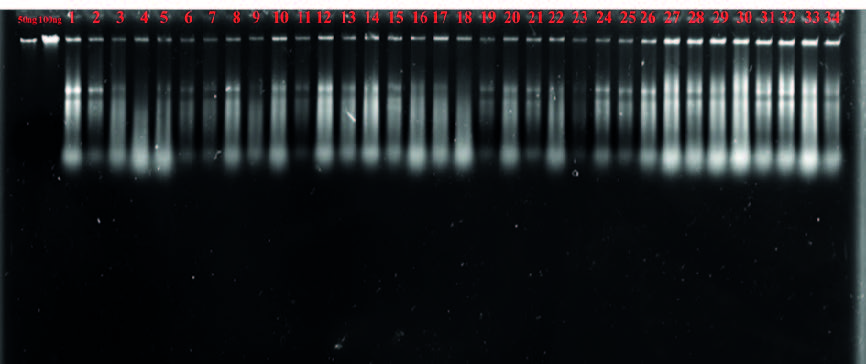
Global food security relies heavily on wheat (Triticum aestivum L.), the major meal of the world because it provides most people with energy and protein from plants. However, many biotic stress factors limit the amount of wheat available to the world. Most importantly, there are many kinds of fungi that infect wheat plants and cause loss in production. The fungal disease of wheat powdery mildew (Blumeria graminis f. sp. tritici) (Bgt) is the most widespread fungal infection of wheat and is responsible for a large amount of yield loss. In this study, the aim was to identify Pm genes associated with resistance to Bgt in 32 registered bread wheat (T. Aestivum L.) varieties using molecular markers. Gradient PCR optimization was performed for the Pm8, Pm24, Pm34, and Pm41 primers; the appropriate annealing temperature was determined as 61 °C for Pm41 and 57 °C for Pm24, and these were used in subsequent analyses. Since the desired level of specific amplification could not be achieved with the Pm8 and Pm34 primers, these primers were not included in the screening analyses. A 1,690 bp target band corresponding to the Pm41 gene was detected in the Sivas 111/33, Sürak M. 1593/51, Haymana 79, Aksel 2000, Bayraktar 2000, Eser, Tosunbey, 4-22, P 8-8, and Melez genotypes. The 218-bp target band associated with the Pm24 gene was observed in the vast majority of the varieties examined, and it was determined that this gene region is more prevalent in the studied material than Pm41. Data show Pm24 and Pm41 molecular marker sites enable early detection of resistant varieties to powdery mildew via parental selection and/or use as sources for breeding in local/regional and comply with registered standards. From this research project results demonstrate that these two markers will help the efforts of developing pathogen-resistant wheat cultivars with the assistance of marker-based technologies.
References
[1] Shiferaw, B., Smale, M., Braun, H. J., Duveiller, E., Reynolds, M., Muricho, G. (2013): Crops that feed the world 10: Past successes and future challenges to the role played by wheat in global food security. Food Security, 5, 291–317. https://doi.org/10.1007/s12571-013-0263-y DOI: https://doi.org/10.1007/s12571-013-0263-y
[2] Shewry, P. R., Hey, S. J. (2015): The contribution of wheat to human diet and health. Food and Energy Security, 4(3), 178–202. https://doi.org/10.1002/fes3.64 DOI: https://doi.org/10.1002/fes3.64
[3] Morgounov, A., Keser, M., Kan, M., Küçükçongar, M., Özdemir, F., Gummadov, N., Muminjanov, H., Zuev, E., Qualset, C. O. (2016): Wheat landraces currently grown in Turkey: Distribution, diversity, and use. Crop Science, 56(6), 3112–3124. https://doi.org/10.2135/cropsci2016.03.0192 DOI: https://doi.org/10.2135/cropsci2016.03.0192
[4] Zair, W., Maxted, N., Brehm, J. M., Amri, A. (2021): Ex situ and in situ conservation gap analysis of crop wild relative diversity in the Fertile Crescent of the Middle East. Genetic Resources and Crop Evolution, 68(2), 693-709. https://doi.org/10.1007/s10722-020-01017-z DOI: https://doi.org/10.1007/s10722-020-01017-z
[5] Hossain, A., Skalicky, M., Brestic, M., Maitra, S., Ashraful Alam, M., Syed, M. A., ... Islam, T. (2021): Consequences and mitigation strategies of abiotic stresses in wheat (Triticum aestivum L.) under the changing climate. Agronomy, 11(2), 241. https://doi.org/10.3390/agronomy11020241 DOI: https://doi.org/10.3390/agronomy11020241
[6] Priya, R. S., Yuvaraj, M., Sharmila, R., Jagathjothi, N., Saranya, M., Suganthi, N., ... Sivaji, M. (2024): Effects of climate change on plant diseases. In Plant quarantine challenges under climate change anxiety (pp. 183-225). Cham: Springer Nature Switzerland. https://doi.org/10.1007/978-3-031-56011-8_7 DOI: https://doi.org/10.1007/978-3-031-56011-8_7
[7] Mapuranga, J., Chang, J., Yang, W. (2022): Combating powdery mildew: Advances in molecular interactions between Blumeria graminis f. sp. tritici and wheat. Frontiers in Plant Science, 13, 1102908. https://doi.org/10.3389/fpls.2022.1102908 DOI: https://doi.org/10.3389/fpls.2022.1102908
[8] Rana, V., Batheja, A., Sharma, R., Rana, A., Priyanka. (2022): Powdery Mildew of Wheat: research progress, opportunities, and challenges. New horizons in wheat and barley research: crop protection and resource management, 133-178. https://doi.org/10.1007/978-981-16-4134-3_5 DOI: https://doi.org/10.1007/978-981-16-4134-3_5
[9] Mu, Y., Gong, W., Qie, Y., Liu, X., Li, L., Sun, N., et al. (2022): Identification of the powdery mildew resistance gene in wheat breeding line Yannong 99102-06188 via bulked segregant exome capture sequencing. Front Plant Sci 13, 1005627. https://doi.org/10.3389/fpls.2022.1005627. DOI: https://doi.org/10.3389/fpls.2022.1005627
[10] Babu, P., Baranwal, D. K., Harikrishna, Pal, D., Bharti, H., Joshi, P., ... Singh, A. (2020): Application of genomics tools in wheat breeding to attain durable rust resistance. Frontiers in Plant Science, 11, 567147. https://doi.org/10.3389/fpls.2020.567147 DOI: https://doi.org/10.3389/fpls.2020.567147
[11] Bhavani, S., Singh, P. K., Qureshi, N., He, X., Biswal, A. K., Juliana, P., ... Mourad, A. M. (2021): Globally important wheat diseases: status, challenges, breeding and genomic tools to enhance resistance durability. Genomic designing for biotic stress resistant cereal crops, 59-128. https://doi.org/10.1007/978-3-030-75879-0_2 DOI: https://doi.org/10.1007/978-3-030-75879-0_2
[12] Li, J., Li, J., Guo, Q., Pang, Y., Wang, C., Yang, Z., ... Zhao, J. (2026): Transferring the Psathyrostachys huashanica 5Ns chromosome into wheat genetic background to enhance powdery mildew resistance. Plant Disease, PDIS-04. https://doi.org/10.1094/PDIS-04-25-0895-RE DOI: https://doi.org/10.1094/PDIS-04-25-0895-RE
[13] Xing, L., Hu, P., Liu, J., Witek, K., Zhou, S., Xu, J., ... Cao, A. (2018): Pm21 from Haynaldia villosa encodes a CC-NBS-LRR protein conferring powdery mildew resistance in wheat. Molecular plant, 11(6), 874-878. https://doi.org/10.1016/j.molp.2018.02.013 DOI: https://doi.org/10.1016/j.molp.2018.02.013
[14] Zhu, S., Liu, C., Gong, S., Chen, Z., Chen, R., Liu, T., ... He, H. (2023): Orthologous genes Pm12 and Pm21 from two wild relatives of wheat show evolutionary conservation but divergent powdery mildew resistance. Plant Communications, 4(2). https://doi.org/10.1016/j.xplc.2022.100472 DOI: https://doi.org/10.1016/j.xplc.2022.100472
[15] Bui, T. P., Le, H., Ta, D. T., Nguyen, C. X., Le, N. T., Tran, T. T., ... Do, P. T. (2023): Enhancing powdery mildew resistance in soybean by targeted mutation of MLO genes using the CRISPR/Cas9 system. BMC Plant Biology, 23(1), 533. DOI: https://doi.org/10.1186/s12870-023-04549-5
[16] Doyle, J.J., Doyle, J.L. (1990): Isolation of plant DNA from fresh tissue. Focus 12:13–15. https://cir.nii.ac.jp/crid/1573950400018579968
[17] Wu, X., Bian, Q., Gao, Y., Ni, X., Sun, Y., Xuan, Y., ... Li, T. (2021): Evaluation of resistance to powdery mildew and identification of resistance genes in wheat cultivars. PeerJ, 9, e10425. https://doi.org/10.7717/peerj.10425 DOI: https://doi.org/10.7717/peerj.10425
[18] Cheng, P., Guo, M., Hao, X., Guo, X., Yao, Q., Guo, Q., ... Wang, B. (2022): Evaluation of powdery mildew resistance and molecular detection of resistance genes in an international wheat collection. Crop Protection, 160, 106033. https://doi.org/10.1016/j.cropro.2022.106033 DOI: https://doi.org/10.1016/j.cropro.2022.106033
[19] Miranda, L. M., Murphy, J. P., Marshall, D., Leath, S. (2006): Pm34: a new powdery mildew resistance gene transferred from Aegilops tauschii Coss. to common wheat (Triticum aestivum L.). Theoretical and Applied Genetics, 113(8), 1497-1504. DOI: https://doi.org/10.1007/s00122-006-0397-9
[20] Li, S., Lin, D., Zhang, Y., Deng, M., Chen, Y., Lv, B., ... Gao, C. (2022): Genome-edited powdery mildew resistance in wheat without growth penalties. Nature, 602(7897), 455-460. https://doi.org/10.1038/s41586-022-04395-9 DOI: https://doi.org/10.1038/s41586-022-04395-9
[21] Schwenke, M. B., Loeillot, T., Griess, V., Poursanidis, D., Petibon, F. (2025): Climate-driven upward spread of forest fires in European mountain regions. https://doi.org/10.21203/rs.3.rs-7658014/v1 DOI: https://doi.org/10.21203/rs.3.rs-7658014/v1
[22] Li, M., Guo, Y., Guo, W., Qiao, H., Shi, L., Liu, Y., ... Wang, Q. (2025): Wheat Powdery Mildew Severity Classification Based on an Improved ResNet34 Model. Agriculture, 15(15), 1580. https://doi.org/10.3390/agriculture15151580 DOI: https://doi.org/10.3390/agriculture15151580
[23] Ma, J., Cheng, Z., Cao, Y. (2025): Artificial intelligence-assisted breeding for plant disease resistance. International Journal of Molecular Sciences, 26(11), 5324. https://doi.org/10.3390/ijms26115324 DOI: https://doi.org/10.3390/ijms26115324
[24] Mustafa, Z. (2024): Assessment of Pm41 gene frequency in Turkish bread wheat germplasm. Plant Protection Bulletin, 64(4), 50-59. https://doi.org/10.16955/bitkorb.1555981 DOI: https://doi.org/10.16955/bitkorb.1555981
[25] Yildirim, A., Sakin, M., Karadag, Y., Gokmen, S., Kandemir, N., Akkaya, M. S., Yildirim, F. (2004): Genetic marker mediated transfer of an alien gene, Pm21, into wheat conferring resistance to powdery mildew. Biotechnology & Biotechnological Equipment, 18(2), 15-19. https://doi.org/10.1080/13102818.2004.10817081 DOI: https://doi.org/10.1080/13102818.2004.10817081
[26] Sönmezoğlu, Ö. A., Yıldırım, A., Türk, Ü., Yanar, Y. (2019): Identification of Powdery Mildew (Blumeria graminis f. sp. tritici) Resistance in Some Durum Wheat Landraces. European Journal of Science and Technology, (17), 944-950. https://doi.org/10.31590/ejosat.646712 DOI: https://doi.org/10.31590/ejosat.646712
[27] Tosun, M., Altınbaş, M., İlker, E., Tonk, F. A., Küçükakça, M. (2011): Inheritance of powdery mildew (Erysiphe graminis) resistance in wheat. Journal of Crop Research, 1, 6-10.
Downloads
Published
How to Cite
Issue
Section
License
Copyright (c) 2026 Journal of Applied Biological Sciences

This work is licensed under a Creative Commons Attribution 4.0 International License.
