
Solvent-dependent antifungal activity of Urtica dioica extracts against soil-borne phytopathogens
DOI:
https://doi.org/10.71336/jabs.1590Keywords:
Urtica dioica, plant extracts, antifungal activity, soil-borne pathogens, solvent effectAbstract
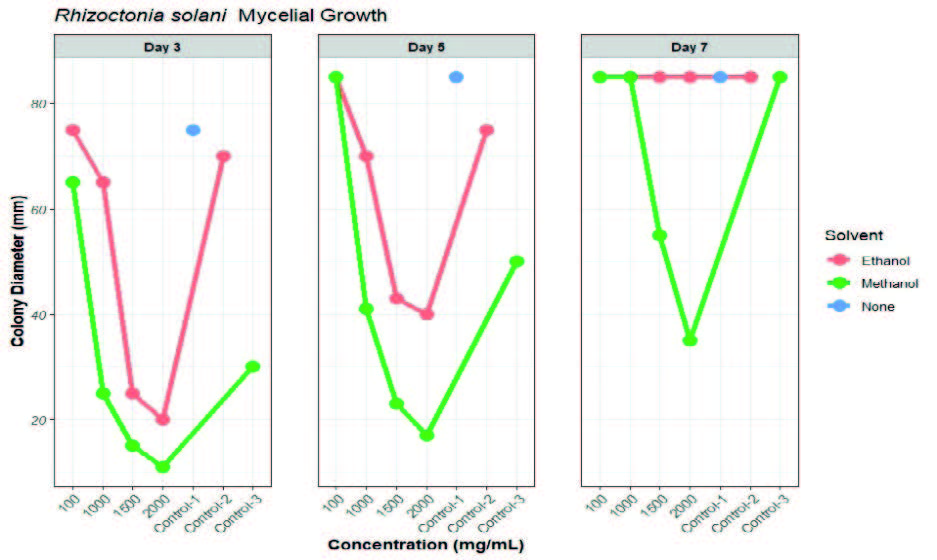
The increasing concerns over environmental risks and resistance development associated with synthetic fungicides have intensified the search for alternative disease management strategies. In this study, the in vitro antifungal activity of methanol and ethanol extracts of Urtica dioica L. was evaluated against three economically important soil-borne phytopathogens, Rhizoctonia solani, Sclerotinia minor, and Sclerotinia sclerotiorum. Extracts were tested at four concentrations (100, 1000, 1500, and 2000 mg mL⁻¹) using the agar dilution method, and mycelial growth inhibition was measured at 3, 5, and 7 days of incubation.
The results showed that antifungal activity was significantly influenced by extract concentration, solvent type, and incubation period. Inhibition increased in a dose-dependent manner across all pathogens. Methanol extracts exhibited higher antifungal activity than ethanol extracts, particularly during early incubation stages. Among the tested pathogens, S. sclerotiorum showed the highest sensitivity, whereas R. solani was less susceptible.
However, a decline in antifungal efficacy over time was observed, indicating limitations related to the stability of active compounds. Overall, the findings suggest that Urtica dioica extracts possess potential as plant-based antifungal agents, particularly against Sclerotinia species, although further studies are required to improve their stability and practical applicability.
References
[1] Ajayi-Oyetunde, O.O., Bradley, C.A. (2018): Rhizoctonia solani: taxonomy, population biology and management of Rhizoctonia seedling disease of soybean. Plant Pathology 67(1): 3-17. DOI: https://doi.org/10.1111/ppa.12733
[2] Smolińska, U., Kowalska, B. (2018): Biological control of the soil-borne fungal pathogen Sclerotinia sclerotiorum: a review. Journal of Plant Pathology 100(1): 1-12. DOI: https://doi.org/10.1007/s42161-018-0023-0
[3] Moura, A.B., Backhouse, D., de Souza Júnior, I.T., Gomes, C. B. (2022): Soilborne pathogens. In: Subsoil Constraints for Crop Production. Springer International Publishing, Cham, pp. DOI: https://doi.org/10.1007/978-3-031-00317-2_9
[4] Baysal-Gurel, F., Kabir, N. (2018): Comparative performance of fungicides and biocontrol products in suppression of Rhizoctonia root rot in viburnum. Journal of Plant Pathology & Microbiology 9(9).
[5] Panth, M., Hassler, S.C., Baysal-Gurel, F. (2020): Methods for management of soilborne diseases in crop production. Agriculture 10(1): 16. DOI: https://doi.org/10.3390/agriculture10010016
[6] Carvalho, F.P. (2017): Pesticides, environment, and food safety. Food and Energy Security 6(2): 48-60. DOI: https://doi.org/10.1002/fes3.108
[7] Šernaitė, L. (2017): Plant extracts: antimicrobial and antifungal activity and appliance in plant protection. Sodininkystė ir Daržininkystė 36: 58-68.
[8] Jiménez-Reyes, M.F., Carrasco, H., Olea, A.F., Silva-Moreno, E. (2019): Natural compounds: a sustainable alternative to phytopathogen control. Journal of the Chilean Chemical Society 64(2): 4459-4465. DOI: https://doi.org/10.4067/S0717-97072019000204459
[9] Lyubenova, A., Georgieva, L., Antonova, V. (2023): Utilization of plant secondary metabolites for plant protection. Biotechnology & Biotechnological Equipment 37(1): 2297533. DOI: https://doi.org/10.1080/13102818.2023.2297533
[10] Mandal, M.K., Domb, A.J. (2024): Antimicrobial activities of natural bioactive polyphenols. Pharmaceutics 16(6): 718. DOI: https://doi.org/10.3390/pharmaceutics16060718
[11] Garcia, R.Á., Juliatti, F.C., Barbosa, K.A.G., Cassemiro, T.A.(2012): Antifungal activity of vegetable oils and extracts against Sclerotinia sclerotiorum. Bioscience Journal 28(1):48-57.
[12] Ojaghian, M.R., Wang, L., Cui, Z.Q., Yang, C., Zhongyun, T., Xie, G.L. (2014): Antifungal and SAR potential of crude extracts derived from neem and ginger against storage carrot rot caused by Sclerotinia sclerotiorum. Industrial Crops and Products 55: 130-139. DOI: https://doi.org/10.1016/j.indcrop.2014.02.012
[13] Nabrdalik, M., Grata, K. (2015): Assessment of antifungal activity of extracts from nettle (Urtica dioica L.) against Alternaria solani. Proceedings of ECOpole 9(2): 473-481.
[14] Pane, C., Francese, G., Raimo, F., Mennella, G., Zaccardelli, M. (2017): Activity of foliar extracts of cultivated eggplants against Sclerotinia lettuce drop disease and their phytochemical profiles. European Journal of Plant Pathology 148(3): 687-697. DOI: https://doi.org/10.1007/s10658-016-1126-0
[15] Wang, Y., Sun, Y., Wang, J., Zhou, M., Wang, M., Feng, J.(2019): Antifungal activity and action mechanism of the natural product cinnamic acid against Sclerotinia sclerotiorum. Plant Disease 103(5): 944-950. DOI: https://doi.org/10.1094/PDIS-08-18-1355-RE
[16] Chakrapani, K., Sinha, B., Chanu, W.T., Chakma, T., Siram, T.(2020): Assessing in vitro antifungal activity of plant extracts against Rhizoctonia solani causing sheath blight of rice (Oryza sativa L.). Journal of Pharmacognosy and Phytochemistry 9(1): 1497-1501.
[17] Wahab, H.A., Malek, A., Ghobara, M. (2020): Effects of some plant extracts, bioagents, and organic compounds on Botrytis and Sclerotinia molds. Acta Agrobotanica 73(2). DOI: https://doi.org/10.5586/aa.7321
[18] Koçak, R., Salman, Ö., Şin, B. (2025): Evaluation of the antifungal effects of Datura stramonium extracts on Sclerotinia sclerotiorum and Rhizoctonia solani under in vitro conditions. Turkish Journal of Agriculture-Food Science and Technology 13(s3): 3747-3752. DOI: https://doi.org/10.24925/turjaf.v13is3.3747-3752.7983
[19] Kazancı, C., Oruç, S., Mosulishvili, M. (2020): Medicinal ethnobotany of wild plants: a cross-cultural comparison around the Georgia–Turkey border in the Western Lesser Caucasus. Journal of Ethnobiology and Ethnomedicine 16(1): 71. DOI: https://doi.org/10.1186/s13002-020-00415-y
[20] Harrison, F., Furner-Pardoe, J., Connelly, E. (2022): An assessment of the evidence for antibacterial activity of stinging nettle (Urtica dioica) extracts. Access Microbiology 4(3): 000336. DOI: https://doi.org/10.1099/acmi.0.000336
[21] Zeković, Z., Cvetanović, A., Švarc-Gajić, J., Gorjanović, S., Sužnjević, D., Mašković, P., Đurović, S. (2017): Chemical and biological screening of stinging nettle leaves extracts obtained by modern extraction techniques. Industrial Crops and Products 108: 423-430. DOI: https://doi.org/10.1016/j.indcrop.2017.06.055
[22] Kregiel, D., Pawlikowska, E., Antolak, H. (2018): Urtica spp.: ordinary plants with extraordinary properties. Molecules 23(7): 1664. DOI: https://doi.org/10.3390/molecules23071664
[23] Azmir, J., Zaidul, I.S.M., Rahman, M.M., Sharif, K.M., Mohamed, A., Sahena, F., Omar, A.K. (2013): Techniques for extraction of bioactive compounds from plant materials: a review. Journal of Food Engineering 117(4): 426-436. DOI: https://doi.org/10.1016/j.jfoodeng.2013.01.014
[24] Andleeb, S., Alsalme, A., Al-Zaqri, N., Warad, I., Alkahtani, J., Bukhari, S.M. (2020): In vitro antibacterial and antifungal properties of the organic solvent extract of Argemone mexicana L. Journal of King Saud University-Science 32(3): 2053-2058. DOI: https://doi.org/10.1016/j.jksus.2020.01.044
[25] Đurović, S., Pavlić, B., Šorgić, S., Popov, S., Savić, S., Petronijević, M., Zeković, Z. (2017): Chemical composition of stinging nettle leaves obtained by different analytical approaches. Journal of Functional Foods 32: 18-26. DOI: https://doi.org/10.1016/j.jff.2017.02.019
[26] Górniak, I., Bartoszewski, R., Króliczewski, J. (2019): Comprehensive review of antimicrobial activities of plant flavonoids. Phytochemistry Reviews 18(1): 241-272. DOI: https://doi.org/10.1007/s11101-018-9591-z
[27] Sehari, M., Kouadria, M., Amirat, M., Sehari, N., Hassani, A. (2020): Phytochemistry and antifungal activity of plant extracts from nettle (Urtica dioica L.). Ukrainian Journal of Ecology 10(1): 1-6.
[28] Boyraz, N., Koçak, R. (2006): In vitro antifungal effects of extracts of some plants. Selcuk Journal of Agriculture and Food Sciences 20(38): 82-87.
[29] Modarresi-Chahardehi, A., Ibrahim, D., Fariza-Sulaiman, S., Mousavi, L. (2012): Screening antimicrobial activity of various extracts of Urtica dioica. Revista de Biología Tropical 60(4): 1567-1576. DOI: https://doi.org/10.15517/rbt.v60i4.2074
[30] Merah, O., Djazouli, Z.E., Zebib, B. (2021): Aqueous extract of Algerian nettle (Urtica dioica L.) as a possible alternative pathway to control some plant diseases. Iranian Journal of Science and Technology, Transactions A: Science 45(2): 463-468. DOI: https://doi.org/10.1007/s40995-021-01061-z
[31] Khakpour, A., Shadmehri, N.A., Amrulloh, H., Kioumarsi, H.(2023): Antibacterial effect of Juglans regia, Citrus sinensis, Vicia faba, and Urtica urens extracts under in vitro conditions. Bioactivities 1(2): 74-80. DOI: https://doi.org/10.47352/bioactivities.2963-654X.195
[32] Mohamed, N.S., Abdul-Sattar, H., Ahmed, D., Esia, M., Abd Alwahab, L. (2024): The biological effects of Urtica dioica extract on some pathogenic bacteria. Journal of Pharmacology and Drug Development 2(2): 57-68.
[33] Motlagh, M. R. S., & Ebrahimi, L. (2024): The antifungal effects of some plant extracts on Sclerotium rolfsii, the causal agent of peanut white stem rot disease. European Journal of Plant Pathology 170(4), 767-787. DOI: https://doi.org/10.1007/s10658-024-02848-7
[34] Ashrafi, Y., Sadeghi, S., Mashhadi, R.H. (2009): Inhibitive effects of barley (Hordeum vulgare) on germination and growth of seedling quack grass (Agropyrum repens). Icelandic Agricultural Sciences 22: 37-43.
[35] Kato-Noguchi, H. (2003): Assessment of allelopathic potential of shoot powder of lemon balm. Scientia Horticulturae 97: 419-423. DOI: https://doi.org/10.1016/S0304-4238(02)00159-0
[36] Sisti, M., De Santi, M., Fraternale, D., Ninfali, P., Scoccianti, V., Brandi, G. (2008): Antifungal activity of Rubus ulmifolius Schott standardized in vitro culture. LWT-Food Science and Technology 41(5): 946-950. DOI: https://doi.org/10.1016/j.lwt.2007.05.012
[37] Benjilali, B., Tantaoui-Elaraki, A., Ayadi, A., Ihlal, M. (1984): Method to study antimicrobial effects of essential oils: application to the antifungal activity of six Moroccan essences. Journal of Food Protection 47(10): 748-752. DOI: https://doi.org/10.4315/0362-028X-47.10.748
[38] İpek, P., Atalar, M. N., Baran, A., Baran, M. F., Ommati, M. M., Karadag, M., ... & Khalilov, R. (2024): Determination of chemical components of the endemic species Allium turcicum L. plant extract by LC-MS/MS and evaluation of medicinal potentials. Heliyon, 10(6). DOI: https://doi.org/10.1016/j.heliyon.2024.e27386
[39] Zaker, M. (2016): Natural plant products as eco-friendly fungicides for plant disease control: a review. The Agriculturists 14(1): 134-141. DOI: https://doi.org/10.3329/agric.v14i1.29111
[40] Ngo, T.V., Scarlett, C.J., Bowyer, M.C., Ngo, P.D., Vuong, Q.V.(2017): Impact of different extraction solvents on bioactive compounds and antioxidant capacity from the root of Salacia chinensis L. Journal of Food Quality 2017: 9305047. DOI: https://doi.org/10.1155/2017/9305047
[41] Truong, D.H., Nguyen, D.H., Ta, N.T.A., Bui, A.V., Do, T.H., Nguyen, H.C. (2019): Evaluation of the use of different solvents for phytochemical constituents, antioxidants, and in vitro anti-inflammatory activities of Severinia buxifolia. Journal of Food Quality 2019: 8178294. DOI: https://doi.org/10.1155/2019/8178294
[42] Körpe, D.A., İşeri, Ö.D., Sahin, F.I., Cabi, E., Haberal, M.(2013): High-antibacterial activity of Urtica spp. seed extracts on food and plant pathogenic bacteria. International Journal of Food Sciences and Nutrition 64(3): 355-362. DOI: https://doi.org/10.3109/09637486.2012.734290
[43] Stanojević, L.P., Stanković, M.Z., Cvetković, D.J., Cakić, M. D., Ilić, D.P., Nikolić, V.D., Stanojević, J.S. (2016): The effect of extraction techniques on yield, extraction kinetics, and antioxidant activity of aqueous-methanolic extracts from nettle (Urtica dioica L.) leaves. Separation Science and Technology 51(11): 1817-1829. DOI: https://doi.org/10.1080/01496395.2016.1178774
[44] Flórez, M., Cazón, P., Vázquez, M. (2022): Antioxidant extracts of nettle (Urtica dioica) leaves: evaluation of extraction techniques and solvents. Molecules 27(18): 6015. DOI: https://doi.org/10.3390/molecules27186015
[45] Lengai, G.M., Muthomi, J.W., Mbega, E.R. (2020): Phytochemical activity and role of botanical pesticides in pest management for sustainable agricultural crop production. Scientific African 7: e00239. DOI: https://doi.org/10.1016/j.sciaf.2019.e00239
[46] Elez Garofulić, I., Malin, V., Repajić, M., Zorić, Z., Pedisić, S., Sterniša, M., Dragović-Uzelac, V. (2021): Phenolic profile, antioxidant capacity and antimicrobial activity of nettle leaves extracts obtained by advanced extraction techniques. Molecules 26(20): 6153. DOI: https://doi.org/10.3390/molecules26206153
[47] Şin, B., Koçak, R., Salman, Ö. (2026): Farklı bölgelerden toplanan Verbascum (sığırkuyruğu) türlerinin metanol ekstraktlarının Rhizoctonia solani’ye karşı antifungal aktivitesi. Turkish Journal of Agriculture-Food Science and Technology 14(2): 351-355. DOI: https://doi.org/10.24925/turjaf.v14i2.351-355.8118
[48] de Queiroz, J.C.E., Leite, J.R.S., Vasconcelos, A.G. (2023): Prospecting plant extracts and bioactive molecules with antimicrobial activity in Brazilian biomes: a review. Antibiotics 12(3): 427. DOI: https://doi.org/10.3390/antibiotics12030427
[49] Hadizadeh, I., Peivastegan, B., Kolahi, M. (2009): Antifungal activity of nettle (Urtica dioica L.), colocynth (Citrullus colocynthis L. Schrad), oleander (Nerium oleander L.) and konar (Ziziphus spina-christi L.) extracts on plant pathogenic fungi. Pakistan Journal of Biological Sciences 12(1): 58-63. DOI: https://doi.org/10.3923/pjbs.2009.58.63
[50] Ferreira, C., Oliveira, R. (2021): Antifungal properties of Urtica dioica against six phytopathogenic fungi. Biology and Life Sciences Forum 3(1): 27. DOI: https://doi.org/10.3390/IECAG2021-09730
[51] Bajpai, V.K., Baek, K.H., Kim, E.S., Han, J.E., Kwak, M.H., Oh, K.H., Choi, G.J. (2012): In vivo antifungal activities of the methanol extracts of invasive plant species against plant pathogenic fungi. The Plant Pathology Journal 28(3): 317-321. DOI: https://doi.org/10.5423/PPJ.NT.04.2012.0056
[52] da Cruz Cabral, L., Pinto, V.F., Patriarca, A. (2013): Application of plant derived compounds to control fungal spoilage and mycotoxin production in foods. International Journal of Food Microbiology 166(1): 1-14. DOI: https://doi.org/10.1016/j.ijfoodmicro.2013.05.026
[53] de Oliveira, S.C., Silva, T.C., Campos, S.N., Ferraudo, G.M., Moreira, S.I., Ríos, K.C., Ceresini, P.C. (2022): Adaptability of Rhizoctonia solani AG-1 IA for mancozeb sensitivity under temperature stress. Bioagro 34(3): 301-310. DOI: https://doi.org/10.51372/bioagro343.9
[54] Hossain, M.M., Sultana, F., Li, W., Tran, L.S.P., Mostofa, M.G.(2023): Sclerotinia sclerotiorum (Lib.) de Bary: insights into the pathogenomic features of a global pathogen. Cells 12(7): 1063. DOI: https://doi.org/10.3390/cells12071063
[55] Derbalah, A.S., Dewir, Y.H., El-Sayed, A.E.N.B. (2012): Antifungal activity of some plant extracts against sugar beet damping-off caused by Sclerotium rolfsii. Annals of Microbiology 62(3): 1021-1029. DOI: https://doi.org/10.1007/s13213-011-0342-2
[56] Mekam, P.N., Martini, S., Nguefack, J., Tagliazucchi, D., Mangoumou, G.N., Stefani, E. (2019): Activity of extracts from three tropical plants towards fungi pathogenic to tomato (Solanum lycopersicum). Phytopathologia Mediterranea 58(3): 573-586.
[57] Schmitt, A., Seddon, B. (2005): Biocontrol of plant pathogens with microbial BCAs and plant extracts: advantages and disadvantages of single and combined use. Modern Fungicides and Antifungal Compounds: 205-225.
[58] Bazana, M.T., Codevilla, C.F., de Menezes, C.R. (2019): Nanoencapsulation of bioactive compounds: challenges and perspectives. Current Opinion in Food Science 26: 47-56. DOI: https://doi.org/10.1016/j.cofs.2019.03.005
[59] Izadi, M., Jorf, S.A.M., Nikkhah, M., Moradi, S. (2021): Antifungal activity of hydrocolloid nanoencapsulated Carum copticum essential oil and Peganum harmala extract on the pathogenic fungus Alternaria alternata. Physiological and Molecular Plant Pathology 116: 101714. DOI: https://doi.org/10.1016/j.pmpp.2021.101714
[60] Cibanal, I.L., Fernández, L.A., Rodriguez, S.A., Pellegrini, C.N., Gallez, L.M. (2022): Propolis extract combined with oregano essential oil applied to lima bean seeds against Sclerotinia sclerotiorum. European Journal of Plant Pathology 164(1): 33-43. DOI: https://doi.org/10.1007/s10658-022-02536-4
[61] Barrera-Méndez, F., Licona Velázquez, L.S., Miranda-Sánchez, D., Anguiano Hernández, A.J., Bonilla-Landa, I., Olivares-Romero, J.L., Noa Carrazana, J.C. (2024): Nanoencapsulation of antifungal Piper schlechtendalii extract in poly(lactide-co-glycolic) acid to enhance photostability. Journal of the Mexican Chemical Society 68(2): 332-343. DOI: https://doi.org/10.29356/jmcs.v68i2.1964
Downloads
Published
How to Cite
Issue
Section
License
Copyright (c) 2026 Journal of Applied Biological Sciences

This work is licensed under a Creative Commons Attribution 4.0 International License.
